 4BLOCKS
ㅁ at a glance
| Letter | ㅁ |
|---|---|
| Sound | m, as in 므 (meu) |
| Name | 미음 (mieum) |
| Romanization | m (마 = ma, 감 = gam) |
| Type | one of the 5 basic Korean consonants: ㄱ ㄴ ㅁ ㅅ ㅇ |
How to pronounce ㅁ, step by step
- Close your lips. Press them together gently, like when you say “mmm” about something tasty.
- Hum through your nose. Keep your lips closed. You should feel a buzz in your lips and nose.
- Open your lips and say 므 (meu). Keep your lips relaxed and flat for the vowel ㅡ. Do not round them.
Good news: the Korean ㅁ is the same as the English m in “mom” or “milk”. If you can say “mom”, you can say ㅁ. The one thing to watch is the practice syllable: say 므 with flat lips, not 무 with round lips. 무 means “radish”, so it is a different word!
Why ㅁ is a square: a picture of your mouth
King Sejong designed Hangul in the 15th century so that the basic consonants are pictures of the mouth. The 1446 book Hunminjeongeum says ㅁ is the shape of the mouth itself.
Say “mmm” and look in a mirror: your lips close into a flat line, and your mouth makes a box. That box is the yellow ㅁ. It is the easiest Hangul letter to remember: ㅁ = mouth = m.
ㅁ is NOT the English o or a square bracket
Some beginners see ㅁ as a box or the letter o. Hangul has a round letter too, ㅇ, which is silent at the start of a syllable. Corners mean ㅁ (m). Round means ㅇ. We meet ㅇ in lesson 5.
Easy Korean words that start with ㅁ
Say the first sound 므 slowly, then the whole word.



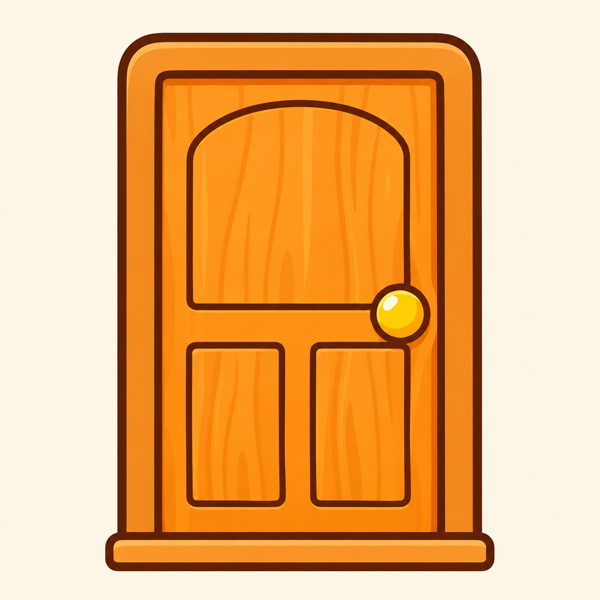
물 is one of the first words travelers need. In Korean restaurants, water is free and you can ask for more with 물 주세요 (mul juseyo, “water, please”).
ㅁ in Korean words you already know
ㅁ appears at the start and at the bottom of many everyday words:
| Korean | Sound | Meaning |
|---|---|---|
| 엄마 | eomma | mom |
| 감사합니다 | gamsahamnida | thank you |
| 김치 | gimchi | kimchi |
| 명동 | myeongdong | Myeongdong (famous shopping street in Seoul) |
엄마 has two ㅁ letters: one at the bottom of 엄 and one at the start of 마. When ㅁ is at the bottom of a syllable, just close your lips and hum: 엄 sounds like “um”. That is why babies all over the world say “mama”: closing the lips is the easiest sound to make.
The ㅁ chant
Clap and chant along with the teacher in the video. Repeat it three times and the sound will stick.
므 므 물! (water)
므 므 머리! (head)
므 므 문! (door)
엄마가 물을 마셔요! (Mom drinks water!)
A Korean sentence with ㅁ
엄마가물을마셔요
엄마가 물을 마셔요 means “Mom drinks water.” Can you find all four ㅁ letters? 엄, 마, 물, 마. Lips close four times!
The colors preview the 4BLOCKS method: blue is who, yellow is what, and red is the action, which always comes last in a Korean sentence. In lesson 2 you met 나비가 나무에 앉아요. Same idea, new blocks.
Common mistakes with ㅁ
- Rounding the lips: 무 instead of 므. The practice sound uses ㅡ, so keep your lips flat after the m.
- Mixing up ㅁ and ㅇ. Square with corners = ㅁ (m). Circle = ㅇ (silent at the start, “ng” at the bottom).
- Forgetting ㅁ at the bottom. In 감, 엄 and 김, close your lips at the end. 감 is not “ga”, it is “gam”.
10-question practice quiz: ㅁ
Answer in your head or out loud, then tap the box to check.
- Which letter says 므: ㄴ or ㅁ?
- ㅁ is a picture of what?
- How do you read 마?
- What does 물 mean?
- What does 모자 mean?
- Read it aloud: 머리. What is it?
- Which word starts with ㅁ: 나비, 문, 고기?
- Square or circle: which one is ㅁ?
- How many ㅁ are in 엄마가 물을 마셔요?
- Is the practice sound 므 the same as 무?
Free printable ㅁ worksheet
Three pages: trace and write ㅁ, find every ㅁ (watch out for ㅇ!), read the four words, the chant, ㄴ or ㅁ practice, a reading drill, word matching and a 10-question test with an answer key. Great for self-study and for teachers.
FAQ: the Korean letter ㅁ
How do you pronounce ㅁ in Korean?
Like the English m. Close your lips, hum through your nose, then open and say 므 (meu).
Why is ㅁ a square?
It is a picture of the mouth, as explained in the 1446 Hunminjeongeum. Closed lips make a box shape.
What is the name of ㅁ?
미음 (mieum). You do not need the name to read, so start with the sound 므.
Is 므 the same as 무?
No. 므 has flat lips (vowel ㅡ). 무 has round lips (vowel ㅜ) and means “radish”.
What is the difference between ㅁ, ㅂ and ㅍ?
All three close the lips. ㅁ is m. Add strokes for ㅂ (a stopped b/p) and ㅍ (p with a puff of air). We cover them in later lessons.